
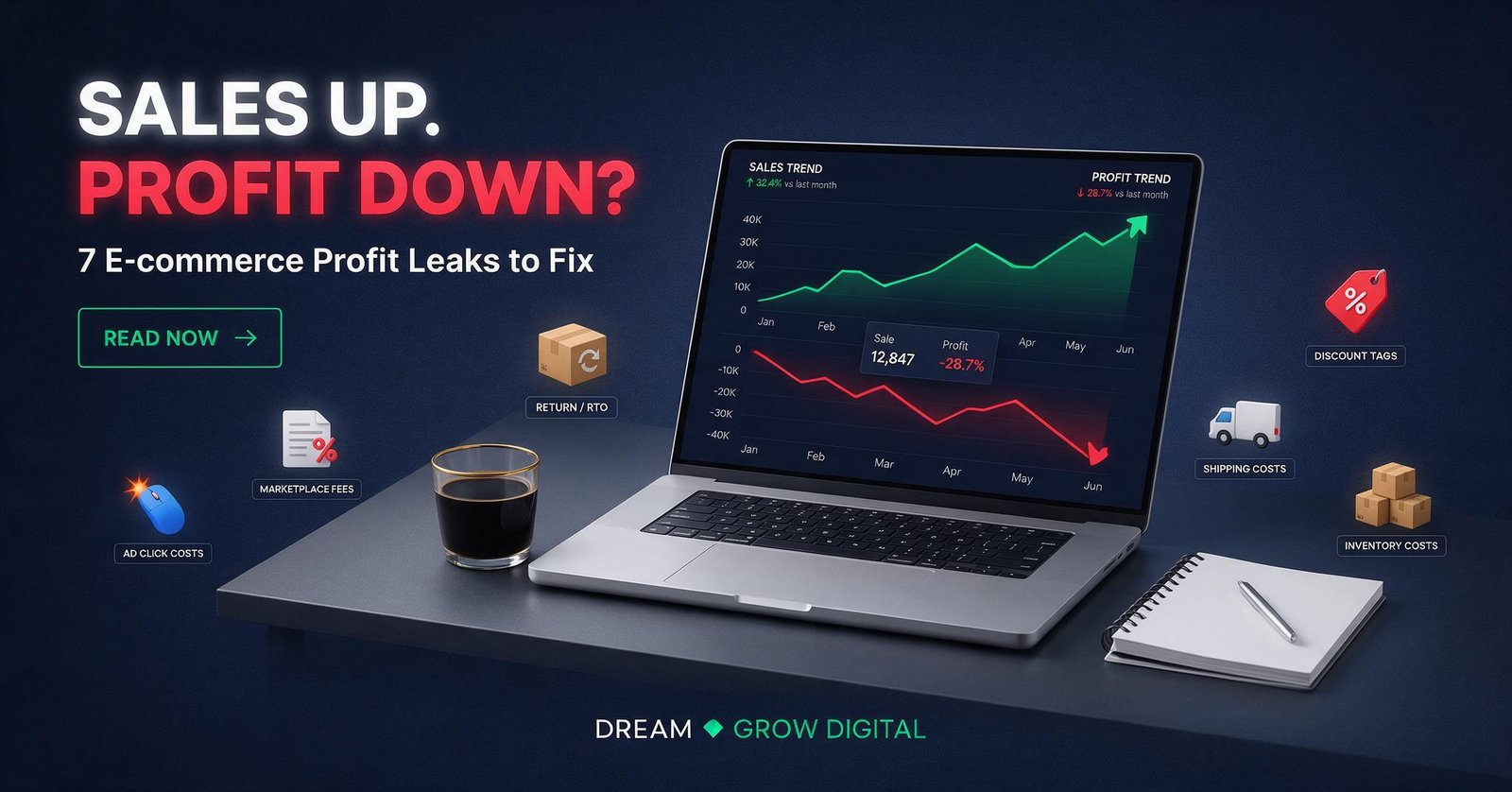
E-commerce Profit Leaks: 7 Reasons Your Sales Are Up but Profit Is Down
Primary keyword: e-commerce profit leaks
Targeted keywords: e-commerce account management, marketplace profit margin, Amazon seller profit
Secondary keywords: RTO in e-commerce, Amazon PPC ROI, marketplace fees, product listing optimization, inventory management, seller account health Many e-commerce sellers celebrate rising sales, only to find that their bank balance is not growing at the same pace. Orders arrive daily, ads run continuously, and the sales dashboard looks impressive—but after marketplace fees, returns, shipping, advertising, and inventory costs, the actual profit can be surprisingly low.
This is one of the most common e-commerce profit leaks for sellers on Amazon, Flipkart, Meesho, Myntra, and other marketplaces. The problem is rarely “low sales.” More often, it is poor unit economics: every order looks profitable on paper, but hidden costs quietly reduce the real margin.
In this guide, you will learn the seven most common reasons your sales are rising while your profit is falling—and how to fix each one.
Why High Sales Do Not Always Mean High Profit
Revenue tells you how much money entered your business. Profit tells you how much money you actually kept.
A product selling at ₹999 may look profitable until you subtract:
-
Product cost
-
Packaging
-
Marketplace referral fee
-
Closing fee
-
Shipping or fulfilment fee
-
Advertising cost
-
Returns and RTO losses
-
GST, payment, and operational costs
Amazon defines seller profit as selling price minus referral fee, closing fee, weight-handling fee, other applicable fees, and product cost. But in real operations, returns, ad spend, damaged inventory, and customer service costs reduce profit even further.sell.amazon+1
That is why e-commerce account management is not only about uploading listings or running ads. It is about protecting your profit at every stage of the selling process.
1. High RTO and Product Returns
Returns are one of the biggest profit killers in Indian e-commerce. A return does not simply reverse a sale; it can create double logistics costs, repacking expenses, damaged-stock losses, and delayed cash flow.
Cash-on-delivery orders are especially risky. Industry discussions estimate India’s RTO rate at around 15–30%, driven by COD orders, incorrect addresses, and customer behaviour. Packaging, volumetric-weight billing, COD remittance charges, and return-to-origin expenses can make an order profitable on paper but loss-making after logistics.
How to reduce RTO losses
-
Use accurate product images, size charts, and specifications.
-
Add real customer reviews and clear usage instructions.
-
Confirm addresses and reduce risky COD orders where possible.
-
Track RTO by pin code, product, variant, and courier partner.
-
Improve packaging to reduce damage-related returns.
-
Remove or redesign products with consistently high return rates.
A strong product listing optimization strategy can directly reduce returns because buyers receive exactly what they expected.
2. Ads Are Running, but Listings Are Not Converting
Many sellers increase their ad budget when sales slow down. But if the product page is weak, more traffic will not solve the problem—it will only increase advertising costs.
A campaign can look healthy inside the ads dashboard while the business still loses money after fees, returns, shipping, discounts, and inventory costs. Weak titles, poor images, missing keywords, low ratings, and unclear offers can drain your Amazon PPC ROI even when clicks are high.
Fix your conversion funnel
Before increasing ad spend, audit:
-
Main image quality
-
Product title and backend keywords
-
Bullet points and description
-
A+ content or enhanced brand content
-
Price competitiveness
-
Reviews and ratings
-
Delivery promise
-
Mobile experience
Your ads should bring qualified traffic, but your listing must convert that traffic into orders. Otherwise, every extra click becomes another e-commerce profit leak.
3. Marketplace Fees Are Higher Than Expected
Marketplace fees are not a single deduction. They usually include referral fees, closing fees, fulfilment or shipping fees, storage charges, return processing fees, and sometimes promotional costs.
These charges vary by category, product size, weight, and fulfilment model. If you price your product only by checking a competitor’s selling price, you may be selling at a loss without realizing it. Marketplace reconciliation is important because untracked fee gaps, refunds, and return deductions can silently reduce payouts.unicommerce
Calculate your true marketplace profit
Use this simple formula:
For example, if you sell a product for ₹999 but pay ₹250 in marketplace fees, ₹120 in shipping, ₹150 in ads, and face a 20% return rate, your real profit may be far lower than expected.
Create a product-wise profit sheet before scaling any SKU. This is a core part of professional e-commerce account management.
4. Wrong Pricing and Excessive Discounts
Discounts can increase orders, but they can also destroy your margin. Many sellers run sales, coupons, and deals without checking whether the final selling price still covers all costs.
A product may receive more orders during a sale, but if the discount removes your entire margin, you are simply buying revenue instead of building profit.
Smarter pricing strategy
-
Calculate the minimum profitable selling price for every SKU.
-
Track competitor prices, but do not blindly match them.
-
Use bundles or value-added offers instead of deep discounts.
-
Set a maximum discount limit for campaigns.
-
Review price changes after fees, ads, and returns.
-
Increase price gradually where demand and reviews support it.
Profitable growth comes from pricing discipline, not from constantly lowering prices.
5. Poor Inventory Management
Inventory problems create two types of losses:
-
Stockouts: You lose sales, rankings, and customer trust.
-
Overstocking: Your money gets stuck in unsold products, storage fees, and dead stock.
Both problems damage your marketplace profit margin. Slow-moving inventory can also lead to long-term storage charges, especially on fulfilment-based models.
Improve inventory control
-
Track daily sales velocity by SKU.
-
Reorder before stock reaches a critical level.
-
Identify slow-moving products early.
-
Avoid bulk purchasing untested products.
-
Monitor storage duration and ageing inventory.
-
Align inventory planning with seasonal demand and sale events.
Good inventory management ensures that your best-selling products remain available without locking your capital in products that do not sell.
6. Weak Seller Account Health
Late dispatch, order cancellations, negative feedback, policy violations, and poor customer response can damage your seller account health. A weak account-health score can reduce visibility, limit promotions, and in serious cases lead to account suspension.
When your account health suffers, even good products may struggle to get orders. You may then spend more on ads to compensate, which further reduces profit.
Protect your account health
-
Dispatch orders on time.
-
Reduce cancellations and invalid tracking.
-
Respond quickly to customer messages.
-
Resolve negative feedback professionally.
-
Monitor policy warnings and performance metrics.
-
Maintain accurate inventory and order updates.
A healthy seller account is not just a compliance requirement—it is a growth asset.
7. No Proper Profit Tracking and Reconciliation
Many sellers check only the sales dashboard and settlement amount. They do not track profit product-wise, ad campaign-wise, or marketplace-wise.
This makes it impossible to know which products are actually making money and which ones are quietly draining cash. Settlement reports may show deductions, but they do not always capture your full product cost, packaging, GST liability, ad spend, return shipping, storage charges, or damaged inventory.unicommerce+1
Track these numbers weekly
-
Revenue after returns
-
Product-wise gross margin
-
Total advertising cost and ACoS
-
RTO percentage
-
Marketplace fees
-
Shipping and fulfilment cost
-
Net profit per order
-
Best and worst-performing SKUs
When you track profit at the SKU level, you can scale winners, fix underperformers, and stop losses quickly.
How E-commerce Account Management Fixes Profit Leaks
Professional e-commerce account management brings all these areas together:
| Area | What an account manager does |
|---|---|
| Listings | Improves titles, images, keywords, and conversion rate |
| Advertising | Controls ad spend and improves PPC ROI |
| Pricing | Calculates real margins after all deductions |
| Inventory | Prevents stockouts and dead stock |
| Returns | Reduces RTO through better listings and operations |
| Account health | Prevents penalties, cancellations, and suspensions |
| Reporting | Tracks real profit, not just sales |
The goal is not only to increase orders. The goal is to increase profitable orders.
Quick Profit Audit Checklist
Ask these questions for every product:
-
Do I know my real profit after all fees?
-
Is my return rate above the category average?
-
Are my ads bringing sales or only clicks?
-
Is my listing converting well on mobile?
-
Am I tracking RTO by product and pin code?
-
Do I have stock for my best-selling SKUs?
-
Are there hidden marketplace deductions I have not reviewed?
-
Is my account health score safe?
-
Do I know my best and worst-performing products?
If you answered “no” to even two questions, your business may already have avoidable profit leaks.
FAQs
Why is my e-commerce business not making profit despite good sales?
Because revenue is not profit. Marketplace fees, shipping, advertising, returns, discounts, and inventory costs can consume a large part of your sales value. You need product-wise profit tracking to identify the exact leak.
What is RTO in e-commerce?
RTO means Return to Origin. It happens when an order is not delivered to the customer and comes back to the seller. RTO increases shipping costs, delays cash flow, and can result in damaged or unsellable inventory.
How can I improve Amazon PPC ROI?
Improve your product listing first, target relevant keywords, remove non-converting search terms, control bids, and track profit after ad spend. Ads should support a converting listing, not compensate for a weak one.
Which costs do sellers usually forget?
Sellers often forget return shipping, return processing fees, packaging, storage fees, damaged inventory, GST on marketplace fees, customer service time, and the real cost of discounts.
How can e-commerce account management increase profit?
It improves listings, controls ads, manages inventory, monitors account health, reduces returns, and tracks real profitability. This helps sellers scale products that make money and fix or remove products that lose money.
Final Thoughts
Growing sales is good, but growing profit is what builds a sustainable e-commerce business. Most sellers do not fail because they cannot get orders—they fail because they do not control the costs hidden behind every order.
If your sales are increasing but profit is not, audit your returns, ads, fees, pricing, inventory, and account health immediately. Fixing even two or three of these e-commerce profit leaks can significantly improve your monthly profit without increasing your ad budget.
Want to find out where your e-commerce business is losing money? Dream Grow Digital can audit your marketplace account, identify profit leaks, and create a practical growth plan for Amazon, Flipkart, Meesho, Myntra, and other platform.