
 Domestic
 International
 Quick Commerce
 Dynamic Web Design
 Ecom Web Design
 Content Marketing
 Landing Page Design
 Customize Web Design
 Website Redesign
 Business Web Design
 Internet Marketing
  Google Map Listing
 City Wise Promotion
 Local SEO Services
 Social Media Marketing
 Google Adwords
 Domain Registration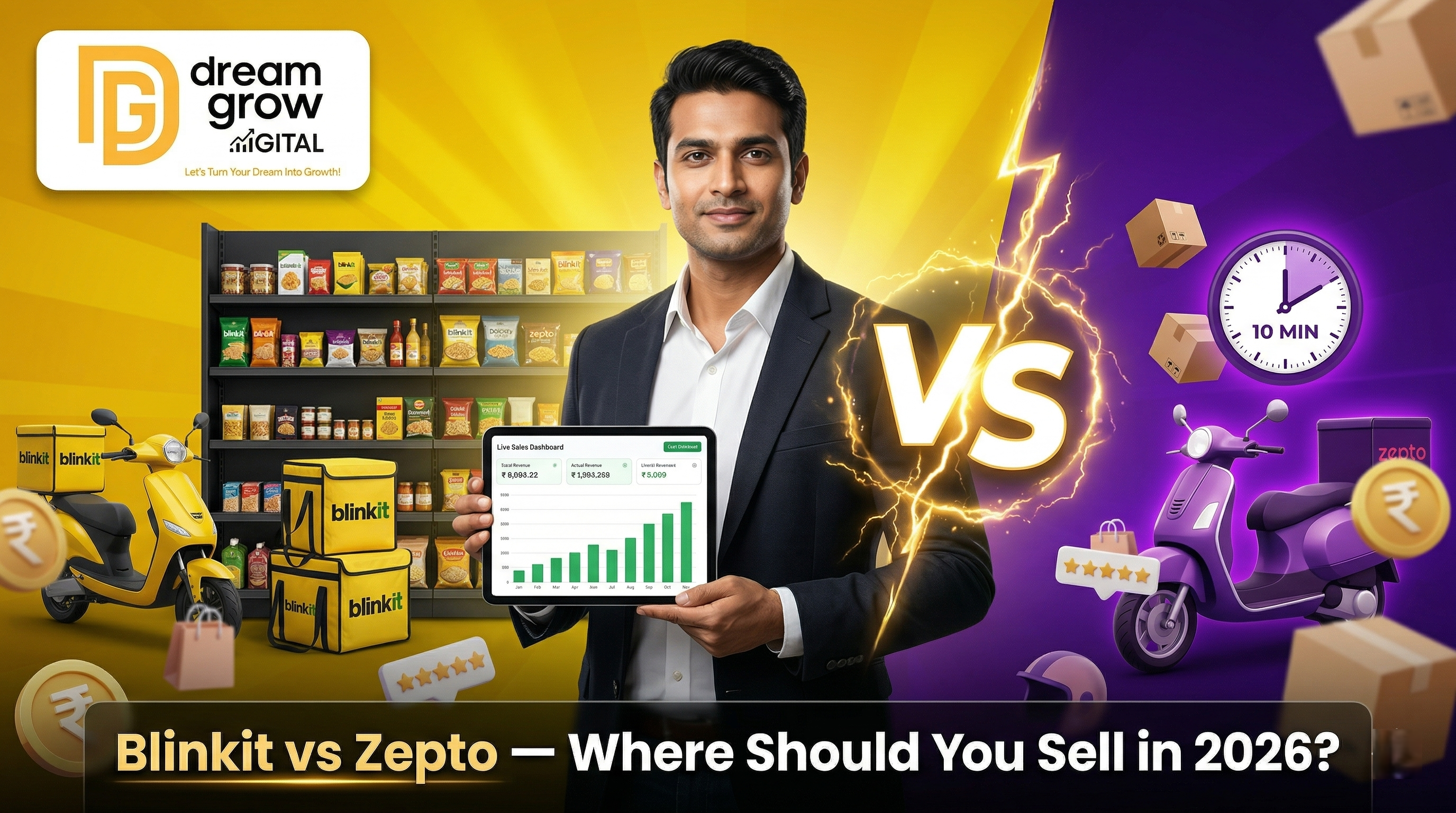
Quick Commerce in India has completely changed how we shop. If you are a business owner, the big question is no longer "if" you should go online, but where. For instant deliveries, the two big names are Blinkit and Zepto. If you want to Sell on Blinkit, you need to understand how the platform works. Both platforms are very aggressive and want to dominate the market. Deciding whether to become a Blinkit Seller or a Zepto Seller is a crucial business decision that can significantly impact your growth in 2026. This blog will compare both platforms on real parameters to help you make the right choice for your business.
Quick Commerce in India 2026 — An Overview
In 2026, Quick Commerce (Q-commerce) is no longer just for groceries. Reports suggest the Q-commerce market size has crossed $10 billion (approx ₹83,000 crores). Speed is everything now. Consumers in Tier 1 and even Tier 2 cities expect everything from smartphones to medicines delivered within 10-20 minutes. This hyper-growth means huge opportunities, but also intense competition. Both Blinkit and Zepto are expanding rapidly to capture this demand, often processing millions of orders monthly.
Blinkit Seller — Platform Overview & Key Features
Blinkit, owned by Zomato, is a leading Q-commerce player. As a Blinkit Seller, you benefit from their massive established user base.
Onboarding Process: The registration is mostly online through their partner portal. You’ll need to provide business details, GSTIN, and FSSAI (for food items). After document verification, there is a physical verification of your stock/store by the Blinkit team before you can start selling.
Commission Structure: Blinkit Seller commissions vary significantly. For FMCG and common groceries, it ranges from 10% to 18%. For high-margin categories like electronics or gourmet items, the commission can go up to 25% or higher. There may be additional fees for logistics and marketing.
City/PIN Code Availability: Blinkit has an extensive reach, dominating major cities like Delhi-NCR, Mumbai, and Bengaluru, and actively expanding into Tier 2 cities in 2026.
Delivery & Inventory Management: Blinkit mostly uses a dark store (warehousing) model. You manage inventory levels, but Blinkit handles the last-mile delivery efficiently. They have strict Service Level Agreements (SLAs) that every Blinkit Seller must follow.
Best Product Categories: Daily essentials, staples, fresh fruits/vegetables, personal care, and increasingly, small electronics and home goods.
Zepto Seller — Platform Overview & Key Features
Zepto, the focused 10-minute delivery app, has grown incredibly fast. The experience of a Zepto Seller is designed for extreme speed.
Onboarding Process: Similar to other platforms, registration is via the Zepto Partner portal. You submit business documents (GST, FSSAI, PAN). Zepto emphasizes quick verification to get sellers onboarded fast.
Commission Structure: Zepto's commissions are also competitive, generally ranging from 15% to 20% for standard FMCG goods. Like Blinkit, commissions for premium or non-food categories can be higher, often negotiable based on volume and category. A Zepto Seller must also account for additional costs related to platform promotions.
Reach & Dark Store Model: Zepto is built almost exclusively on the dark store model. They carefully choose micro-markets in Tier 1 cities to ensure 10-minute delivery. Their reach is extremely dense in metros, and they are expanding strategically into selected Tier 2 hubs by 2026.
Best Product Categories: Fresh produce, daily groceries, snacks, cold drinks, and high-frequency impulse purchase items where instant delivery is critical.
Blinkit Seller vs Zepto Seller — Head-to-Head Comparison
Here is a quick comparison to help you analyze which platform might suit your business needs better as a Blinkit Seller or Zepto Seller.
| Parameter | Blinkit Seller | Zepto Seller |
| Onboarding Ease | Moderate (includes physical stock verification) | Relatively Fast |
| Commission % | 10% - 25%+ (highly category dependent) | 15% - 20%+ (negotiable on volume) |
| City Reach | Very Wide (Metros, Tier 1, expanding Tier 2) | Dense in Metros, Strategic Tier 2 presence |
| Best For | Established brands, diverse catalog, Tier 2 reach | High-frequency goods, FMCG, ultra-fast demand |
| Support Quality | Moderate (Ticket-based, can be slow) | Decent (Improving with scale) |
| Payment Cycle | Weekly or Fortnightly (usually T+7 or T+14) | Generally Weekly |
Summary: As a Blinkit Seller, you gain access to a wider geographical audience and a more diversified user base (thanks to the Zomato ecosystem). However, a Zepto Seller may experience faster onboarding and potentially faster payments, benefiting from Zepto's focused delivery model. The best choice really depends on your specific product type and target city availability.
Which Platform is Right for Which Seller?
Which platform is right for you depends on what you sell and where you are.
New Seller / Small Business: Being a Blinkit Seller might offer better long-term potential due to their larger market reach and brand recognition. If you’re just starting, the credibility of Blinkit can help.
FMCG / High-Volume Brand: You should probably register as both a Blinkit Seller and a Zepto Seller. These platforms are ideal for products with high turn-around, and you should maximize your presence.
Local Kirana / Niche Producer: If you are a specialized local player (e.g., gourmet baker, organic farm), you might find better traction as a Blinkit Seller in certain areas where they support local vendor initiatives, allowing you to leverage their delivery network.
D2C Brand: If your D2C brand relies on impulse purchases or rapid replacement (like personal care or unique snacks), becoming a Zepto Seller is highly recommended due to the dense metro presence where your target customers live.
Pro Tips for Selling on Both Platforms
- Inventory is King: Q-commerce works only if stock is available. Avoid stock-outs at all costs. Every successful Blinkit Seller uses reliable inventory software.
- Optimize Packaging: Packaging must be robust and stackable. When your product is moving fast to a dark store, damaged goods are your loss.
- Competitive Pricing: Q-commerce customers are price-sensitive. Use both platforms’ analytical tools to monitor competitors. You cannot survive as a Blinkit Seller with uncompetitive pricing.
- Fast Cataloging: Get new products listed instantly. The speed of cataloging can determine who gets the first-mover advantage for a trending product.
- Analyze Performance: Regularly check metrics like order fill rate, acceptance time, and customer ratings. A successful Blinkit Seller knows their data inside out.
Conclusion
In 2026, both platforms offer incredible opportunities. There is no single "better" platform; it’s about alignment with your business goals. Being a Blinkit Seller provides massive scale and established trust across many regions. Becoming a Zepto Seller offers access to a focused, hyper-local audience in key metros. The ideal strategy for most medium to large businesses will be a multi-platform approach. Choose the right platform for your business, complete the registration process, and start today!
Frequently Asked Questions (FAQs)
Q1: What documents are required to become a Blinkit Seller?
To sell on Blinkit, you primarily need a GST Registration certificate, FSSAI License (if you are selling food items), a copy of your PAN card, and valid address proof (like a current electricity bill or rent agreement). This documentation is essential for starting the onboarding process.
Q2: Who charges more commission between Blinkit and Zepto?
The commission structure for both platforms is complex and depends on many factors. However, generally, Zepto's standard commission range (15-20%) can be slightly higher than Blinkit's entry-level commission. However, a correct comparison is only feasible category-to-category because Blinkit Seller categories have high variation.
Q3: Can I sell on both platforms simultaneously?
Yes, absolutely! Most established brands use both platforms as simultaneous channel partners to maximize their marketing reach and order volume. This is one of the recommended strategies for growing a profitable quick commerce business.
Q4: What is the minimum order quantity (MOQ) for a Zepto Seller?
There is no fixed standard minimum order quantity declared by the platform. However, inventory push typically happens daily based on pending orders and forecasts. This is crucial for maintaining dark store demands and efficient operations.
Q5: Which products sell the most in quick commerce in 2026?
Daily consumption products like dairy products, fresh produce, snacks, cold beverages, and household supplies dominate quick commerce in 2026. However, convenience products like small accessories, personal hygiene items, and pet supplies are also showing exceptional growth.