

 Domestic
 International
 Quick Commerce
 Dynamic Web Design
 Ecom Web Design
 Content Marketing
 Landing Page Design
 Customize Web Design
 Website Redesign
 Business Web Design
 Internet Marketing
  Google Map Listing
 City Wise Promotion
 Local SEO Services
 Social Media Marketing
 Google Adwords
 Domain Registration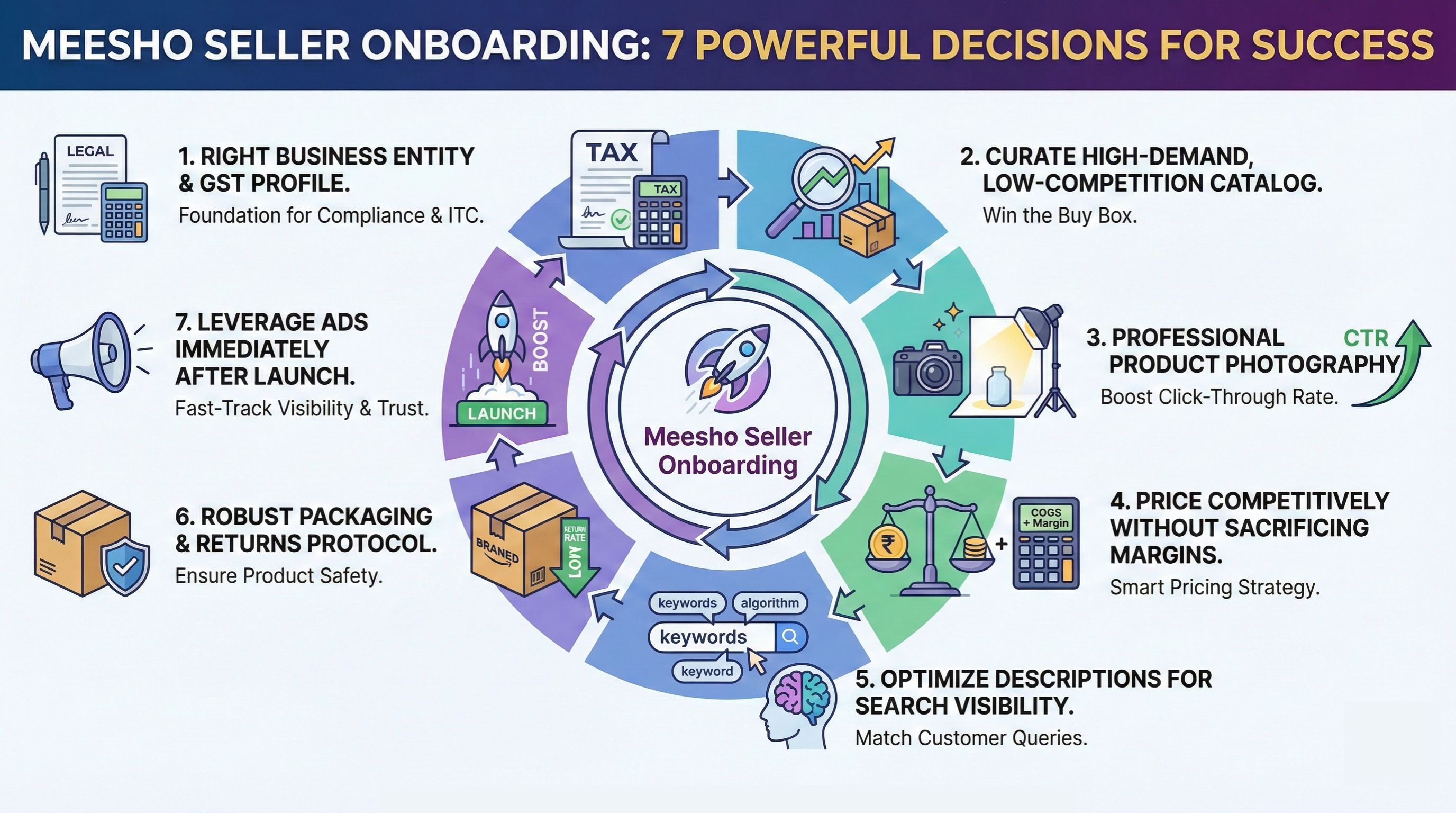
The Indian e-commerce landscape is shifting rapidly, and Meesho has emerged as a dominant force for small businesses and resellers. For new entrepreneurs, the Meesho Seller Onboarding process is more than just filling out forms; it is the foundational step that determines your long-term visibility and profitability. Many sellers rush through the registration, unaware that their initial inputs directly influence their Meesho Quality Score. This score is a critical metric that the algorithm uses to rank your products, meaning your very first decisions can dictate whether you land on page one or get lost in the crowd.
Successful onboarding requires a strategic mindset. It isn't just about uploading products; it’s about making calculated choices regarding your catalog, pricing, and logistics before you even make your first sale. By focusing on the right details during the Meesho Seller Onboarding phase, you can avoid the common pitfalls that cause new accounts to stagnate.
Table of Contents
- Decision 1: Selecting the Right Business Entity and GST Profile
- Decision 2: Curating a High-Demand, Low-Competition Catalog
- Decision 3: Investing in Professional Product Photography
- Decision 4: Pricing Competitively Without Sacrificing Margins
- Decision 5: Optimizing Product Descriptions for Search Visibility
- Decision 6: Establishing a Robust Packaging and Returns Protocol
- Decision 7: Leveraging Ads Immediately After Launch
- Conclusion
Decision 1: Selecting the Right Business Entity and GST Profile
Why It Matters
The very first step of Meesho Seller Onboarding involves legal documentation. The type of GST registration you hold (Regular vs. Composition) impacts your tax liability and your ability to claim Input Tax Credit (ITC).
Impact on Performance
If you choose the wrong tax structure, your profit margins may shrink due to unclaimable taxes. Furthermore, a mismatch between your bank account details and your business name can lead to verification delays, stalling your launch.
Common Mistakes to Avoid
- Registering as a Composition Dealer while planning to sell interstate (which is restricted).
- Using a personal savings account instead of a current account, which can cause payment reconciliation issues later.
Decision 2: Curating a High-Demand, Low-Competition Catalog
Why It Matters
One of the most powerful decisions you make during Meesho Seller Onboarding is defining what you sell. Meesho attracts a specific demographic—value-conscious buyers looking for trends.
Impact on Performance
Uploading a generic catalog that mirrors thousands of other sellers reduces your chances of winning the "Buy Box." Unique designs or bundled offers tend to perform better than single, generic commodities.
Common Mistakes to Avoid
- Listing seasonal winter products at the start of summer.
- Ignoring the "Trending" section on the dashboard which offers clues on what is currently selling hot.
Decision 3: Investing in Professional Product Photography
Why It Matters
In e-commerce, the customer cannot touch the product. Your images are your only sales pitch. During the Meesho Seller Onboarding setup, the quality of the initial images you upload sets the tone for your brand trust.
Impact on Performance
High-definition images with a clean white background generally yield a higher Click-Through Rate (CTR). A higher CTR signals to the Meesho algorithm that your product is relevant, boosting your organic reach.
Common Mistakes to Avoid
- Using watermarked images from other marketplaces.
- Uploading blurry photos or photos with distracting backgrounds that violate platform guidelines.
Decision 4: Pricing Competitively Without Sacrificing Margins
Why It Matters
Meesho is known for its competitive pricing. However, a common trap during Meesho Seller Onboarding is engaging in a "race to the bottom." You must calculate your settlement amount precisely.
Impact on Performance
You can access the meesho supplier portal to use their price recommendation tools. However, blindly following these recommendations without knowing your own Cost of Goods Sold (COGS) can lead to losses. Smart pricing ensures you have room for potential returns and marketing costs.
Common Mistakes to Avoid
- Forgetting to factor in shipping weights and potential return penalties.
- Setting a price so low that you cannot afford to run ads later.
Decision 5: Optimizing Product Descriptions for Search Visibility
Why It Matters
This is where expert guidance often comes into play. Firms like Dream Grow Digital often emphasize that an algorithm cannot "see" your product; it reads your data. Your title and description are how the system matches your product to a customer's search query.
Impact on Performance
A well-optimized listing during Meesho Seller Onboarding helps your products appear in relevant search results. If you sell a "Women's Cotton Kurti," but your title just says "Blue Top," you will miss out on high-intent traffic.
Common Mistakes to Avoid
- Leaving the description field blank or minimal.
- Stuffing keywords that are irrelevant to the product (e.g., adding "Shoes" in a "Watch" listing), which can lead to account suspension.
Decision 6: Establishing a Robust Packaging and Returns Protocol
Why It Matters
Returns are an inevitable part of e-commerce, especially in fashion and lifestyle categories. Your decision on packaging quality directly influences the return rate.
Impact on Performance
If your product arrives damaged due to poor packaging, the customer will initiate a return. High return rates negatively impact your account health and visibility. Once you complete your Meesho Seller Onboarding, your focus must shift to ensuring the product survives the logistics chain intact.
Common Mistakes to Avoid
- Using packaging material that is too thin or unbranded.
- Failing to include a size guide in the listing, which is the #1 cause of apparel returns.
Decision 7: Leveraging Ads Immediately After Launch
Why It Matters
Organic reach takes time to build. The decision to allocate a small budget for Meesho Ads right after your Meesho Seller Onboarding is complete can fast-track your growth.
Impact on Performance
New accounts often struggle with visibility. Running a low-budget ad campaign helps you gather initial orders, reviews, and ratings. These early signals are crucial for establishing trust with future buyers.
Common Mistakes to Avoid
- Waiting for "organic sales" before running ads (which may never come for new accounts).
- Spending a large budget on unproven products rather than testing small amounts first.
Conclusion
The Meesho Seller Onboarding process is not a mere administrative task; it is a strategic launchpad. The seven decisions outlined above—from legal entity selection and catalog curation to pricing and logistics—form the backbone of a successful seller journey.
Many new sellers make the mistake of rushing through the meesho supplier portal setup, only to face visibility issues later. By taking the time to optimize your images, calculate your margins accurately, and plan for returns, you position your business for sustainability. Remember, the goal isn't just to get onboarded; the goal is to build a high-quality, scalable business that consistently delights customers.