

 Domestic
 International
 Quick Commerce
 Dynamic Web Design
 Ecom Web Design
 Content Marketing
 Landing Page Design
 Customize Web Design
 Website Redesign
 Business Web Design
 Internet Marketing
  Google Map Listing
 City Wise Promotion
 Local SEO Services
 Social Media Marketing
 Google Adwords
 Domain Registration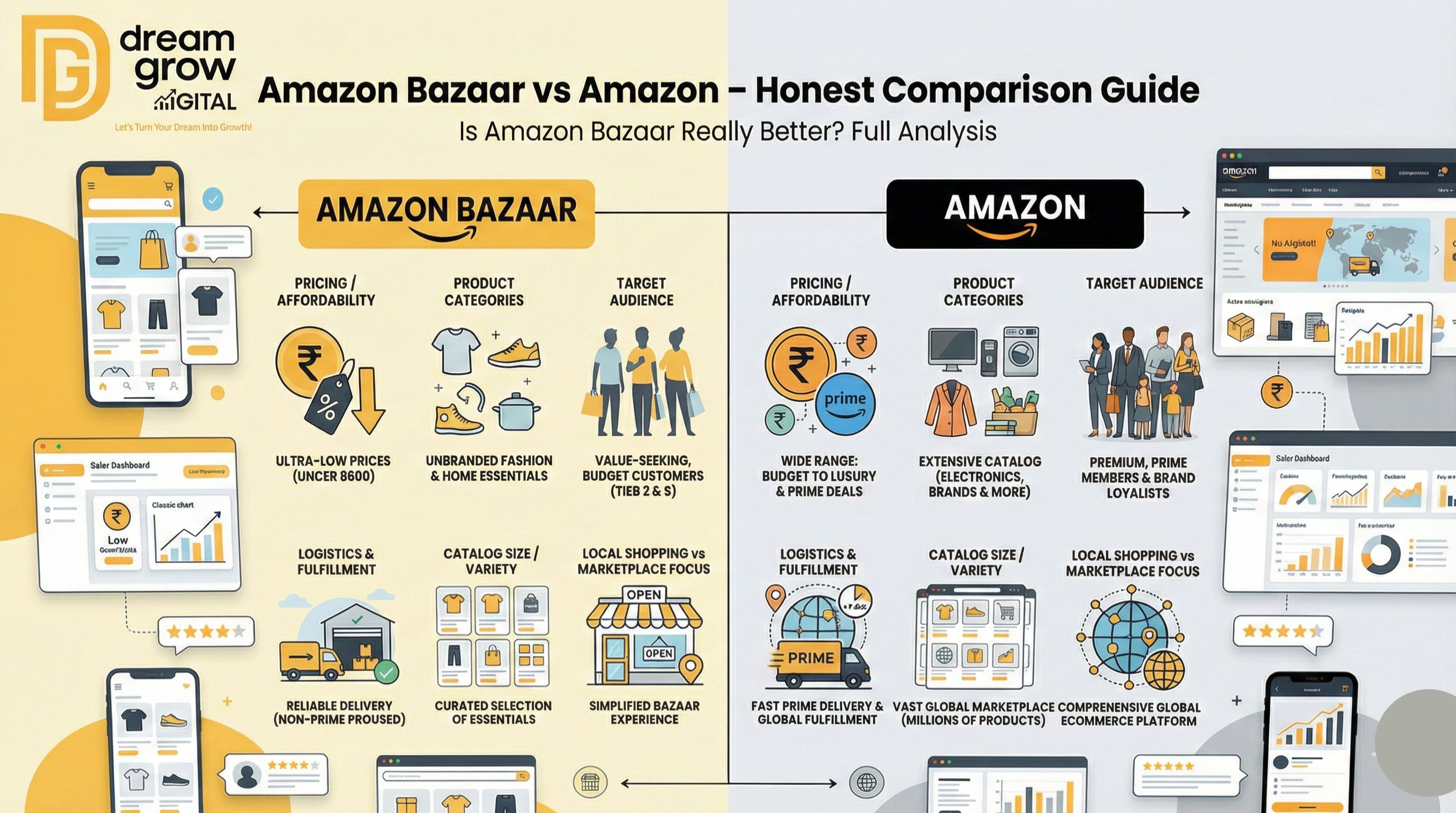
The Indian ecommerce landscape is constantly evolving, with major players adapting to diverse consumer needs. Amazon India, already a dominant force, recently introduced a new segment designed to capture the massive value-commerce market: Amazon Bazaar. This has led to significant confusion among both shoppers and sellers. Is it a new app? Is it cheaper? Which platform offers better opportunities?
Understanding these nuances is crucial, especially if you are a seller navigating Amazon Seller Onboarding or a buyer looking for the best deals. This blog provides a factual, professional breakdown of the differences between the standard Amazon platform and the new Amazon Bazaar to help you decide which is right for you.
What is Amazon Bazaar?
Before diving into the comparison, let’s clarify what Amazon Bazaar actually is.
Amazon Bazaar is not a separate mobile application. It is a specialized storefront integrated within the existing Amazon India app specifically designed for budget-conscious customers. It focuses primarily on unbranded or lesser-known fashion and home products that are typically low-priced (often under ₹600). It is Amazon's answer to competitors in the low-cost marketplace segment, offering a distinct Amazon shopping experience focused on value.
Detailed Breakdown: Amazon vs. Amazon Bazaar
While both platforms operate under the Amazon umbrella, they serve entirely different purposes and target audiences.
1. Product Categories and Pricing Model
Amazon (Main Platform): The main platform is the "everything store." You will find premium electronics, branded fashion, appliances, groceries, and high-end goods. Pricing varies widely, from budget items to luxury products costing lakhs.
Amazon Bazaar: This segment is hyper-focused. Amazon Bazaar products are predominantly in the unbranded fashion (clothing, shoes, accessories) and home essentials categories. The primary appeal here is ultra-low pricing, catering to customers looking for functional items without the brand premium.
2. The Buyer Experience
Amazon: The standard Amazon experience prioritizes speed, variety, and trust in brands. Customers often rely on Prime benefits for fast, often one-day or two-day delivery. The focus is on convenience and access to a vast catalog of known quality.
Amazon Bazaar for customers: The experience here is centered around "budget shopping on Amazon Bazaar." The interface is designed to highlight deals and low prices. While customers still enjoy Amazon's reliable return policies, the delivery timelines might not always match Prime speeds, as the logistics model for ultra-low-cost items sometimes differs.
3. Seller Fees and Commission Structure
This is perhaps the most critical differentiator for businesses.
Amazon: Sellers on the main platform pay varying referral fees depending on the category, closing fees, and shipping fees. While it offers immense reach to premium buyers, the cost structure reflects the premium service. Sellers manage these aspects through Amazon Seller Central.
Amazon Bazaar seller commission: To ensure products remain ultra-cheap for buyers, Amazon Bazaar offers significant Amazon Bazaar seller benefits. The platform charges zero to very low referral fees on items below a certain price point (typically those under ₹600 in specific categories). This low-cost marketplace structure allows sellers of unbranded goods to maintain decent margins despite low selling prices.
Pros and Cons: A Quick View
Standard Amazon Platform
Pros:
- Access to premium, high-spending customers.
- Supports all categories, including high-value electronics.
- Prime badge eligibility for faster delivery promises.
- Established trust for branded goods.
Cons:
- Higher competition from major brands.
- Higher seller fees compared to the Bazaar segment.
Amazon Bazaar
Pros:
- Excellent for budget shopping on Amazon Bazaar.
- Significant Amazon Bazaar seller benefits, including near-zero commissions on low-ASP items.
- Simplified listing requirements for unbranded goods.
- Access to a massive tier-2 and tier-3 customer base.
Cons:
- Not suitable for premium or high-value branded products.
- Average order value (AOV) is lower.
- Delivery speeds may sometimes differ from standard Prime expectations.
Who Should Choose What? The Verdict
The question isn't really "Is Amazon Bazaar better than Amazon?" but rather "Which platform serves my current needs?"
For Buyers:
- Choose standard Amazon if: You want branded electronics, fast Prime delivery, premium goods, or specific high-quality items.
- Choose Amazon Bazaar if: You are looking for daily-use fashion or home items on a tight budget and brand names are not a priority.
For Sellers:
- Choose standard Amazon if: You sell branded products, electronics, or high-value items where customers expect premium service and rapid delivery.
- Choose Amazon Bazaar if: You are a manufacturer or reseller of unbranded, low-cost fashion or home essentials and want to maximize volume without high commission costs.
Navigating these distinct marketplace ecosystems can be complex for growing businesses. Dream Grow Digital supports ecommerce brands with end-to-end marketplace growth, professional onboarding, and strategic account management to ensure you are positioned on the right platform for maximum profitability.
Conclusion
The comparison between Amazon vs Amazon Bazaar highlights Amazon India's strategy to cater to every Indian shopper. Standard Amazon remains the go-to for premium, branded, and fast-delivery needs. Meanwhile, Amazon Bazaar serves as an efficient, low-cost marketplace for budget-conscious consumers and sellers of unbranded goods.
Understanding these differences ensures buyers get the best value and sellers choose the most profitable channel for their inventory. Assess your needs, define your budget or product type, and choose the storefront that aligns with your goals.
Frequently Asked Questions (FAQs)
1. Do I need to download a separate app for Amazon Bazaar? No. Amazon Bazaar is accessed within the standard Amazon India shopping app. It is a dedicated section inside the main application.
2. Are products on Amazon Bazaar fake or lower quality? Amazon Bazaar products are typically unbranded or from lesser-known regional manufacturers. They are not necessarily "fake," but they are budget-oriented items where buyers should manage expectations regarding premium quality.
3. Can I sell electronics on Amazon Bazaar? Currently, Amazon Bazaar is focused primarily on fashion, accessories, and home essentials. High-value electronics are better suited for the main Amazon platform.
4. What are the main Amazon Bazaar features for sellers? The key feature is the relaxed fee structure (zero or low commission) for low-priced items, making it easier to compete in the value segment.